publications
The full list is also on my Google Scholar profile.
2026
-
ICRA
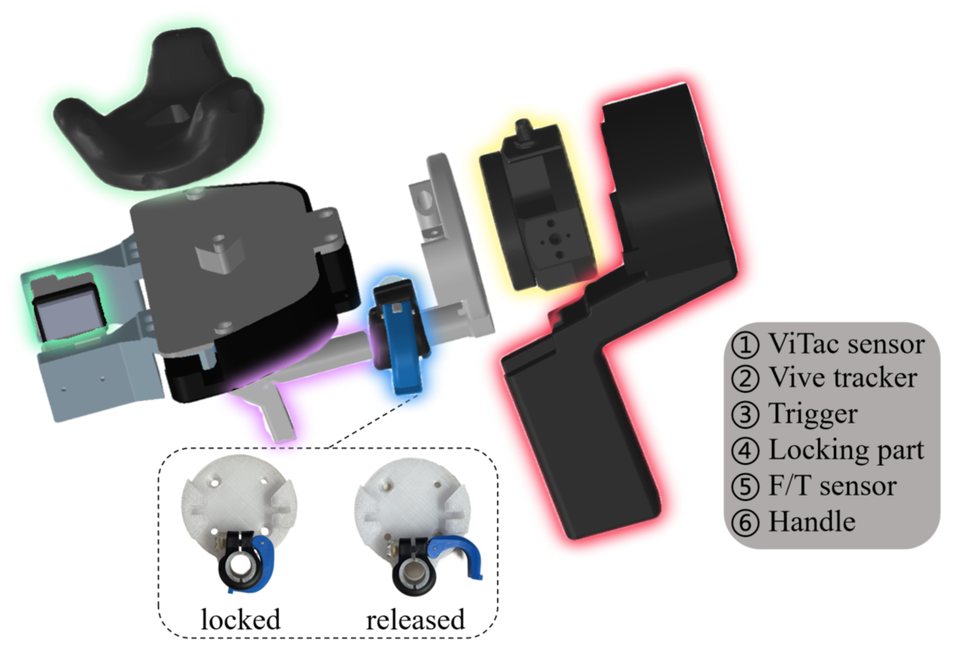 TacUMI: A Multi-Modal Universal Manipulation Interface for Contact-Rich TasksIEEE International Conference on Robotics and Automation (ICRA), 2026
Task decomposition is critical for understanding and learning complex long-horizon manipulation tasks. Especially for tasks involving rich physical interactions, relying solely on visual observations and robot proprioceptive information often fails to reveal the underlying event transitions. This raises the requirement for efficient collection of high-quality multi-modal data as well as robust segmentation method to decompose demonstrations into meaningful modules. Building on the idea of the handheld demonstration device Universal Manipulation Interface (UMI), we introduce TacUMI, a multi-modal data collection system that integrates additionally ViTac sensors, force-torque sensor, and pose tracker into a compact, robot-compatible gripper design, which enables synchronized acquisition of all these modalities during human demonstrations. We then propose a multi-modal segmentation framework that leverages temporal models to detect semantically meaningful event boundaries in sequential manipulations. Evaluation on a challenging cable mounting task shows more than 90 percent segmentation accuracy and highlights a remarkable improvement with more modalities, which validates that TacUMI establishes a practical foundation for both scalable collection and segmentation of multi-modal demonstrations in contact-rich tasks.
2025
-
IROS
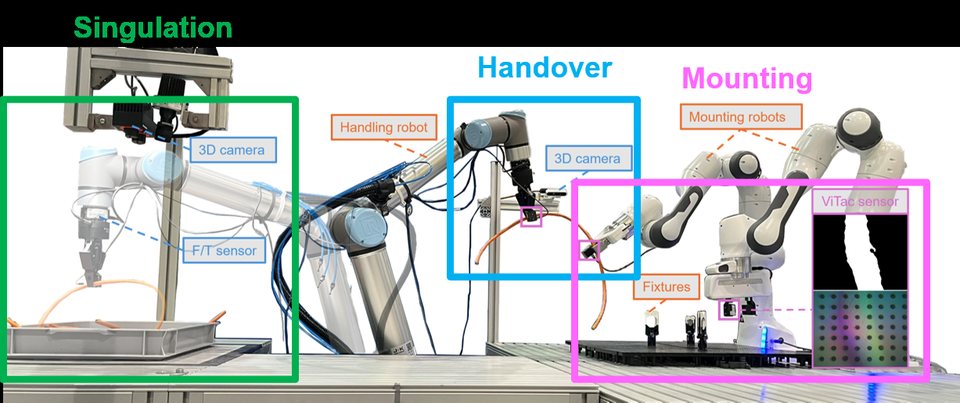 Multi-Robot Assembly of Deformable Linear Objects Using Multi-Modal PerceptionIEEE/RSJ International Conference on Intelligent Robots and Systems (IROS), 2025
Industrial assembly of deformable linear objects (DLOs) such as cables offers great potential for many industries. However, DLOs pose several challenges for robot-based automation due to the inherent complexity of deformation and, consequentially, the difficulties in anticipating the behavior of DLOs in dynamic situations. Although existing studies have addressed isolated subproblems like shape tracking, grasping, and shape control, there has been limited exploration of integrated workflows that combine these individual processes. To address this gap, we propose an object-centric perception and planning framework to achieve a comprehensive DLO assembly process throughout the industrial value chain. The framework utilizes visual and tactile information to track the DLO's shape as well as contact state across different stages, which facilitates effective planning of robot actions. Our approach encompasses robot-based bin picking of DLOs from cluttered environments, followed by a coordinated handover to two additional robots that mount the DLOs onto designated fixtures. Real-world experiments employing a setup with multiple robots demonstrate the effectiveness of the approach and its relevance to industrial scenarios.
-
ICRA
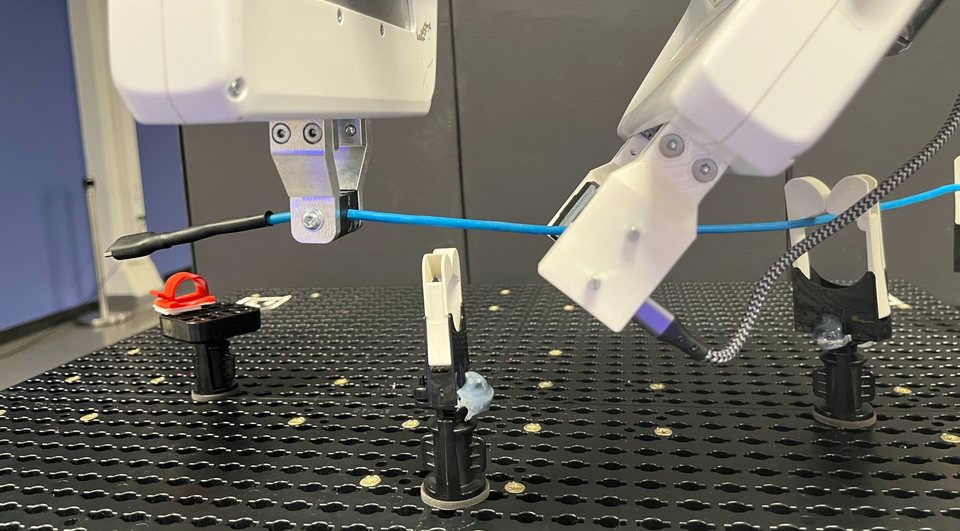 LEMMo-Plan: LLM-Enhanced Learning from Multi-Modal Demonstration for Planning Sequential Contact-Rich Manipulation TasksIEEE International Conference on Robotics and Automation (ICRA), 2025
Large Language Models (LLMs) have gained popularity in task planning for long-horizon manipulation tasks. To enhance the validity of LLM-generated plans, visual demonstrations and online videos have been widely employed to guide the planning process. However, for manipulation tasks involving subtle movements but rich contact interactions, visual perception alone may be insufficient for the LLM to fully interpret the demonstration. Additionally, visual data provides limited information on force-related parameters and conditions, which are crucial for effective execution on real robots. In this paper, we introduce an in-context learning framework that incorporates tactile and force-torque information from human demonstrations to enhance LLMs' ability to generate plans for new task scenarios. We propose a bootstrapped reasoning pipeline that sequentially integrates each modality into a comprehensive task plan. This task plan is then used as a reference for planning in new task configurations. Real-world experiments on two different sequential manipulation tasks demonstrate the effectiveness of our framework in improving LLMs' understanding of multi-modal demonstrations and enhancing the overall planning performance.